
Jump to:
– Step 1 — Audit Your Backlink Profile
– Step 2 — Choose Your Strategy
– Step 3 — Find and Qualify Prospects
– Step 5 — Track, Measure, and Scale
Link building is one of the most direct ways to improve your site’s rankings. Getting other websites to link to yours tells Google that your content is worth surfacing to users. This guide covers how to do link building in SEO from start to finish — auditing your current profile, selecting the right tactics, finding and qualifying prospects, writing outreach that gets responses, and tracking results.
What Is SEO Link Building? (And Why It Still Matters in 2026)
SEO link building is the process of acquiring backlinks — hyperlinks from other websites pointing to yours — to increase your site’s authority in search engines. Each backlink acts as a third-party endorsement. Google uses those endorsements to decide which pages deserve to rank.
How Google Uses Backlinks as a Ranking Signal
Google’s founders, Sergey Brin and Larry Page, built PageRank on one core idea: a page linked to by many credible sources is more trustworthy than one linked to by few. That principle remains active today. Google’s “How Search Works” documentation confirms that links help determine which pages are the most relevant and authoritative for a given query.
Link equity — the ranking authority a link transfers from the linking page to your page — flows based on the quality of the source. A link from a major news outlet passes more equity than ten links from obscure, low-traffic blogs. Google’s algorithms evaluate link quality continuously, not just at crawl time.
In 2024, a leaked Google API document confirmed that site-level authority signals derived from link data continue to influence rankings. While Google’s public statements have occasionally downplayed links, the underlying ranking data tells a different story.
The Difference Between Good Links and Bad Links
A good backlink comes from a relevant, trustworthy domain, sits in editorial content, uses natural anchor text, and was earned on merit. A bad backlink comes from a low-quality or unrelated site, was placed artificially through purchase, exchange, or automation, or uses over-optimized anchor text that looks manipulative.
Ahrefs’ research on over one billion web pages found a clear correlation between referring domains — unique sites linking to a page — and that page’s organic traffic. Volume matters, but only when the links are genuinely high quality. Google’s Link Spam updates in 2022 and 2023 sharpened its ability to detect and neutralize low-quality link patterns. Links from private blog networks, link exchanges, and mass guest posting at scale are increasingly identified and discounted or penalized.
Key Link Metrics You Need to Understand
Before starting any campaign, learn these four metrics. You’ll use them throughout every step of the process.
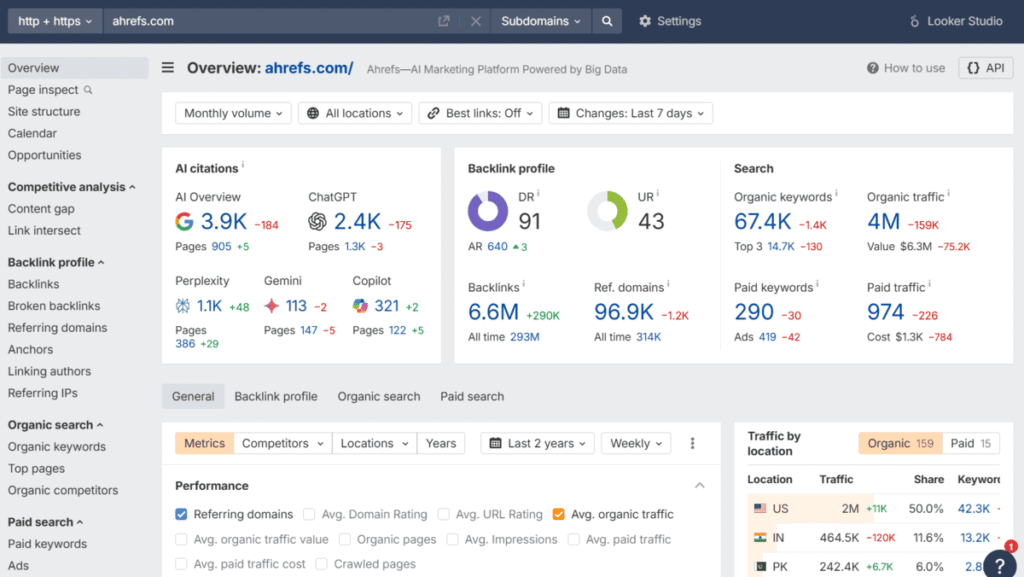
- Domain Rating (DR): Ahrefs’ 0–100 scale measuring the strength of a site’s backlink profile. A link from a DR 70 site carries more weight than one from a DR 20 site.
- Domain Authority (DA): Moz’s equivalent metric, also on a 0–100 scale. Neither DR nor DA is a Google metric — they are third-party proxies useful for evaluating link prospects.
- Referring Domains: The count of unique websites linking to a page or domain. More referring domains from quality sites generally means higher rankings. Raw link count matters less than source diversity.
- Anchor Text: The clickable text of a link. Descriptive, varied anchor text helps Google understand what your linked page covers. An unnatural concentration of exact-match commercial anchor text can trigger Google’s spam filters.
Step 1 — Audit Your Current Backlink Profile
Before building new links, understand where you stand today. An audit tells you which pages already have authority, which need help most, and whether any harmful links are pointing at your site.
How to Run a Backlink Audit
Open Google Search Console and navigate to “Links.” This free report shows which external sites link to your domain and which of your pages receive the most links. It isn’t exhaustive — Search Console only shows links Google has indexed — but it’s the right starting point and costs nothing.
For a complete picture, run your domain through Ahrefs Site Explorer or Semrush Backlink Analytics. Both tools show your full backlink profile, the DR distribution of linking sites, your anchor text breakdown, and your historical link acquisition rate. Look specifically for:
- Links from sites with very low DR (under 10) and near-zero organic traffic
- An unusually high proportion of exact-match commercial anchor text
- Links from sites in completely unrelated niches
- A sudden spike in links at a specific date, which may indicate purchased or network links
If you find a large volume of suspicious links, Google’s Disavow Tool in Search Console lets you tell Google to ignore specific domains when evaluating your profile.
How to Perform a Backlink Gap Analysis Against Competitors
A backlink gap analysis shows which sites link to your competitors but not to you. These are pre-qualified prospects — sites that have already shown willingness to link to content in your niche.
In Ahrefs, use the Link Intersect tool. Enter your domain and two to four competitor domains. The tool returns a list of sites that link to those competitors but not to you. Filter by DR 40 or above and sort by referring page traffic to surface the best opportunities. In Semrush, the same function lives under “Backlink Gap” in the Link Building toolkit. Export the results and you have your first outreach prospect list.
Identifying Your Most Linkable Pages
Not every page on your site needs link building effort. Focus on three page types:
- Commercial target pages: Product, service, or category pages ranking in positions 11–20. A targeted link campaign can push these to page 1.
- Pillar content pages: Comprehensive guides or resource pages already attracting some links that can become authority hubs.
- Linkable assets: Original research, free tools, calculators, data studies, or templates that other writers will want to cite.
Once you identify your strongest candidate, build at least one page worth linking to before contacting any site. Outreach for thin or generic content produces poor conversion rates regardless of how well-written the emails are.
Internal linking note: Once you acquire links to a specific page, add internal links from that page to other pages you want to rank. This distributes the equity your new backlinks bring in and ensures it circulates throughout your site rather than concentrating on one page.
Step 2 — Choose Your Link Building Strategy
Six tactics produce consistent results in 2026. The right starting point depends on your site’s current authority, your available time, and your budget.
Here’s a reference table before the breakdown:
| Tactic | Difficulty | Time to Results | Best For | Risk Level |
| Guest Posting | Medium | 1–3 months | Niche-relevant brand building | Low (if editorial) |
| Skyscraper Technique | High | 2–4 months | Competitive niches | Low |
| Broken Link Building | Medium | 1–2 months | Resource-heavy niches | Low |
| Digital PR / Data Studies | High | 1–6 months | High-authority editorial links | Very Low |
| Resource Page Outreach | Low–Medium | 1–2 months | Curated link pages | Low |
| HARO / Media Outreach | Low | 2–8 weeks | Authority citations, quick wins | Very Low |
| Link Reclamation | Low | 1–4 weeks | Existing brand mentions | Very Low |
| PBN / Paid Link Schemes | — | — | Not recommended | Very High |
Guest Posting
Write an original article for a relevant publication in your niche and include a contextual link back to your site. The host site gets free content; you get an editorial backlink. The critical dividing line is quality. Guest posts on editorial sites with real audiences and genuine standards are effective. Guest posts placed on sites that exist only to sell placements are not. Google’s guidelines specifically flag “large-scale article campaigns with keyword-rich anchor text links” as a link spam pattern. Find opportunities by searching Google for `[your niche] + “write for us”` or `[your niche] + “contribute”`. Target sites with DR 40+, genuine organic traffic, and published articles by named authors.
The Skyscraper Technique
Developed by Brian Dean at Backlinko, this tactic works in three stages. First, find a piece of content in your niche with a significant number of backlinks. Second, create a noticeably better version — more comprehensive, more accurate, better structured, or more current. Third, contact the sites linking to the original and let them know a stronger resource now exists. The word “noticeably” matters here. A marginal improvement won’t convert. Your content needs to be a clear, obvious upgrade for the outreach to produce results.
Broken Link Building
Find pages in your niche containing links to deleted or moved content (returning 404 errors). Contact the site owner, flag the broken link, and suggest your content as a replacement. Response rates for this tactic are higher than for cold link requests because you’re solving a real problem. In Ahrefs, enter a competitor’s URL in Site Explorer, go to Backlinks, and filter by “404” under Target URL. This shows pages that other sites once linked to but that no longer exist. If your site already covers the same topic, you have an immediate outreach opportunity.
Digital PR and Data-Driven Content
Commission original research — an industry survey, an analysis of publicly available data, a unique study — and pitch the findings to journalists and bloggers. When reporters use your data, they link to your source page. This method produces some of the highest-authority links available, often from national news outlets and major publications with DR 80+. A single data study can generate links from 50 or more unique high-authority domains, as Search Engine Journal has documented in multiple case studies. The upfront investment in commissioning or compiling original data pays dividends that outreach alone cannot match.
Resource Page Link Building
Many sites maintain curated lists of tools, guides, and resources for a specific field. Find them by searching Google for `[your topic] + “useful resources”` or `[your topic] + intitle:”resources”`. If your content would genuinely serve the page’s readers, email the owner with a short, specific pitch explaining what your resource covers and why it fits their list. This tactic has lower competition than editorial pitches and requires no new content creation if you already have a strong resource.
HARO and Media Outreach (2026 Alternatives)
HARO was discontinued by Cision in late 2023. Current platforms serving the same function include Qwoted, Featured.com, Source of Sources (SOS by Agility PR), and Help a B2B Writer. Sign up for one or two, respond to relevant journalist queries with concise expert commentary, and earn editorial links when your quotes are published. Response quality matters more than volume. A short, specific answer to the journalist’s actual question outperforms a long, generic pitch.
Step 3 — Find and Qualify Link Prospects

How to Identify High-Authority, Relevant Websites
Start with the gap analysis from Step 1. Then extend your prospect list with two additional methods.
Export the full backlink profiles of your top two to three competitors from Ahrefs or Semrush. Sort by DR and filter for sites that link to multiple competitors but not to you. These sites have demonstrated both topical relevance and willingness to link to content like yours — the two most important qualities in a prospect.
Use Google search operators to find additional targets. Searching `site:.edu [your topic]` surfaces educational resources, which typically carry high domain authority. Searching `inurl:links [your niche]` surfaces curated link pages that may not appear in competitor backlink data.
Qualifying Prospects: What to Check Before You Outreach
Not every high-DR site is worth your time. Before adding a domain to your outreach list, verify these four things:
– Organic traffic: Open the site in Ahrefs and check estimated monthly visits. A site with DR 55 but 400 monthly organic visitors may have inflated its metrics through cheap links. Look for a minimum of several thousand monthly organic visitors as a signal of legitimacy.
– Topic relevance: Is the site’s subject genuinely related to yours? A link from an unrelated niche carries less weight and is harder to justify in your outreach.
– Content quality: Read two or three recent articles on the site. If quality is low, the link’s value — to your profile and to Google — is limited regardless of the site’s DR score.
– Link placement patterns: Where does the site place outbound links? Editorial in-body links carry significantly more weight than links buried in author bios, sidebars, or footers.
Use LinksToro to check important website and page details.
Building a Prospect List and Tracking Spreadsheet
Set up a spreadsheet with these columns before sending a single email:
- Target Domain — the site you want a link from
- Target URL — the specific page where the link should appear
- Site DR and Monthly Traffic
- Contact Name and Contact Email
- Outreach Status — not contacted / emailed / replied / placed / declined
- Date of Last Contact
- Notes
Update this spreadsheet after every action. It prevents duplicate outreach, makes follow-up systematic, and lets you calculate conversion rates once the campaign has run for a few weeks.
Step 4 — Execute Outreach and Follow Up

How to Write a Link Building Outreach Email (With Template)
Most link building outreach emails fail because they’re generic. Site owners receive dozens of near-identical pitches every week. Your email needs to give the recipient a specific, personal reason to say yes.
Three things every outreach email needs:
1. A reference to something specific on their site — not a vague compliment
2. A clear value proposition for the recipient, not just for you
3. One specific ask, stated plainly
Here is a guest post outreach template built on those principles:
Subject: Guest post idea for [Publication Name]
Hi [First Name],
I came across your article on [specific article title] — the part about
[specific detail or section] was useful. I write about [your topic] and
work in this space professionally.
I’d like to contribute a guest post to [publication name]. One topic that
might work well for your readers:
[Working title of your proposed article]
[One sentence explaining why this topic would be useful to their audience —
not why it’s useful to you]
Would that be worth exploring? Happy to send a full outline first if it
helps you decide.
This template works because it references something specific on the recipient’s site, proposes one clear topic rather than asking them to generate ideas, and offers an outline as a low-friction next step.
Personalisation Tactics That Increase Response Rates
Personalisation means showing the recipient you actually engaged with their site — not just inserting their first name. Reference a specific article they published, mention a data point they cited, or note something recent on their site. This takes three to five minutes per prospect and separates your email from the mass of identical pitches.
Industry data from BuzzStream and Respona both show that personalised outreach emails generate response rates two to three times higher than templated mass emails. The approach that works best: personalise the first two sentences of every email while keeping the core pitch consistent across the campaign.
Follow-Up Cadence: When and How Often to Follow Up
Send one follow-up email if you don’t receive a response within five to seven days. Keep it brief — one sentence referencing your original email and asking if they had a chance to review it. Two messages total is the standard for professional link building outreach. Sending more than two moves into territory most recipients find intrusive and damages your sender reputation for future campaigns.
Step 5 — Track, Measure, and Scale Your Campaign
Key Metrics to Track
Monitor these three metrics monthly throughout any active campaign:
New referring domains: The number of unique new sites that linked to your domain in the month. This is the clearest direct indicator of campaign progress. Ahrefs and Semrush both show this in their overview dashboards.
Domain Rating trajectory: Track your site’s DR over time in Ahrefs. A consistent upward trend confirms the links you’re acquiring carry real authority. A flat or declining DR suggests you’re losing links faster than you’re gaining them.
Target page ranking positions: Check the rankings of your target pages in Google Search Console or your rank tracking tool. Link acquisition should correlate with ranking movement within 6–12 weeks for most targets.
Referral traffic from specific placements is a useful secondary signal. If a site links to you and sends zero visitors over several months, the link lives on a page with no real audience — worth knowing before you pursue more placements on the same site.
Tools to Monitor Your Backlink Profile Over Time
Four tools cover most link monitoring needs. Here’s a practical comparison:
| Tool | Cost | Best Use |
| Google Search Console | Free | Track your own backlinks; spot ranking changes |
| Ahrefs Site Explorer | From $29/month* | Full backlink profile, competitor analysis, link alerts |
| Semrush Backlink Audit | From $139.95/month | Toxic link detection; disavow file export |
| Moz Link Explorer | Free (limited) | DA checks; basic backlink sampling |
Set up weekly link alerts in Ahrefs for new and lost links to your domain. Lost links matter as much as new ones — if a site removes your link or goes offline, your referring domain count drops. Monitor this and replace high-value lost placements when possible.
Link Building Tactics to Avoid in 2026
Private Blog Networks (PBNs): Google detects PBN footprints and applies manual penalties to buyers and sellers alike.
Paid dofollow links without proper attributes: Purchasing links without `rel=”sponsored”`violates Google’s spam policies directly. According to Google Search Central, buying or selling links that pass PageRank is an explicit guideline violation.
Large-scale guest posting with exact-match anchor text: High-volume guest post campaigns on low-quality sites, particularly using identical commercial keyword anchors, are named in Google’s link spam documentation.
Reciprocal link exchanges: Systematic “you link to me and I’ll link to you” arrangements are a guideline violation when done for ranking purposes.
Automated link building tools: Any software creating links without human editorial judgment produces signals Google discounts or penalizes. A manual link spam penalty appears in Search Console under “Security & Manual Actions.” Recovery requires identifying and removing (or disavowing) offending links, then submitting a reconsideration request — a process that can take weeks.
How to Scale What’s Working
After running a full campaign cycle, identify which tactics produce links at the highest conversion rate on your specific site. If broken link building converts at 12% and cold guest post pitches convert at 4%, put more time into broken link building.
Scaling typically means one of two things: increasing outreach volume within your highest-converting tactic, or handing off specific parts of the workflow — prospect research, first-contact emails — to a freelancer or managed service. Both approaches work. The key is that link quality standards don’t slip as volume increases.
Frequently Asked Questions
What is SEO link building in plain terms?
SEO link building is the practice of getting other websites to link to yours. Each external link tells Google that your content has merit. Google uses those signals to determine where your pages should rank in organic search results.
How do I start link building on a brand-new website?
Start with the lowest-effort tactics first: ask business partners or suppliers for a link, claim unlinked brand mentions, and submit to a small number of legitimate industry directories. Publish one strong piece of content before contacting editorial sites. Guest posting on smaller niche publications is more achievable for new sites than immediately targeting high-authority publications with strict editorial requirements.
How many backlinks does a page need to rank?
The answer depends entirely on your target keyword’s competition level. A low-competition query may rank with fewer than ten referring domains. A competitive head term may require hundreds from high-authority sites. Use Ahrefs or Semrush to check how many referring domains the current top 10 pages have for your target keyword — that gives you a real competitive baseline rather than a generic number.
How long does link building take to move rankings?
Most pages see ranking movement within 6–12 weeks of acquiring links from authoritative domains. Links from sites with DR 80 or above sometimes show effects within three to four weeks. For competitive keywords, sustained link building over 6–12 months is typically needed before reaching page 1.
What should I do about harmful links pointing at my site?
Run your backlink profile through Ahrefs or Semrush. Look for links from sites with very low DR, high spam scores, or no real organic traffic. Try to remove them by contacting the linking sites directly. If you can’t get them removed, upload a disavow file to Google’s Disavow Tool in Search Console. Only disavow links you’re confident are harmful — removing legitimate links can hurt your rankings.
Leave a Reply